
Claude vs Grok: Which is better in 2026?
Decide by what you want the assistant to keep up with and to make.
Tested hands-on: 4 tests on a MacBook Pro (M1 Pro), October 21, 2026. How we tested
Some links on this page are affiliate links. If you buy through them we may earn a commission at no extra cost to you. This never affects our verdicts.
Quick answer
- Choose Claude if: You mostly work with long documents, research or code.
- Choose Grok if: You want an assistant that keeps up with X and the news and also makes pictures and video.
- Price at a glance: Claude: Free plan; paid from $20/mo · Grok: Free plan; paid from $8/mo
At a glance
 Claude |  Grok | |
|---|---|---|
| Free plan | Yes | Yes |
| Paid plans | From $20/mo | From $8/mo |
| Our tests | Won 0 of 43 ties | Won 1 of 43 ties |
| Best for | Writers, analysts and developers who work with long documents or code and do not need image generation. | People who want an assistant that follows the news on X and the web, makes images and videos, and comes in one plan with Cursor and X Premium benefits. |
Claude, from Anthropic, and Grok, from xAI (now branded SpaceXSI), are general-purpose AI chat assistants. Both answer questions, write and debug code, read the files you upload, search the web and hold voice conversations, on the web and in apps for iOS and Android, and both have a free plan. Grok searches X as well as the web in real time and creates images and videos; Claude generates no images but allows larger files: 500 MB each, against 150 MB for most files on Grok. Each comes with a coding tool: Claude Code on Claude's paid plans, Cursor with Grok's subscription. The plans, limits and privacy settings below come from each vendor's own pricing and help pages.
Pricing
| Plan | Monthly | Yearly (12-month total) |
|---|---|---|
| Claude | ||
| FreeSonnet and Haiku models; up to 5 projects | Free Free plan | |
| Pro$17/month with annual billing ($200 billed up front) | $20/mo | $200/yr ($16.67/mo) |
| Max 5xBilled monthly only; includes $100/month in API credits | $100/mo | no yearly price |
| Max 20xBilled monthly only; includes $200/month in API credits | $200/mo | no yearly price |
| Team (Standard seat)Per user/month; $20 per user/month billed annually; 2 to 150 seats | $25/mo | $240/yr ($20/mo) |
| Team (Premium seat)Per user/month; $100 per user/month billed annually; 5x Standard usage | $125/mo | $1,200/yr ($100/mo) |
| EnterprisePer user, billed annually ($20/seat/month), 20-seat minimum, plus usage at API rates | no monthly price | $240/yr, billed yearly ($20/mo) |
| Grok | ||
| FreeLimited chat, voice, image generation and Grok Build; no video generation, API access or Grok Bot | Free Free plan | |
| Plus$80 billed yearly (listed as $7/month); base usage pool shared with Cursor; no video generation or Grok Bot; not for teams | $8/mo | $80/yr ($6.67/mo) |
| Premium$300 billed yearly (listed as $25/month); 4x Plus usage; video generation, Grok Bot, X Premium+ benefits | $30/mo | $300/yr ($25/mo) |
| Super$1,000 billed yearly (listed as $84/month); 15x Plus usage; priority model access at peak times | $100/mo | $1,000/yr ($83.33/mo) |
| Ultra$2,000 billed yearly (listed as $167/month); 50x Plus usage; earliest access to products and models | $200/mo | $2,000/yr ($166.67/mo) |
| TeamsFrom $30 per user/month: Premium $30, Super $100 or Ultra $200 seats, mixable; SAML/OIDC SSO, central billing | $30/mo | no yearly price |
| EnterpriseContact sales; pooled usage, invoice billing, SCIM, audit logs | Custom | |
Prices checked on .
Features compared
| Feature | Claude | Grok |
|---|---|---|
| Free tier | Yes · Sonnet and Haiku; web search, memory, 5 projects | Yes · Limited chat, voice and images; no video or API access |
| File upload | Yes · Up to 20 files per chat, 500 MB each | Yes · Up to about 100 files at once on the web (20 on Android); most files up to 150 MB |
| Web search | Yes · All plans | Yes · Real-time web and X search with live citations |
| Image generation | No · Diagrams and charts only (HTML/SVG) | Yes · Grok Imagine, limited on Free; video generation from Premium |
| Voice mode | Yes · All plans | Yes · Voice conversations, incl. Free with limits |
| Memory/projects | Yes · Memory on all plans; Free up to 5 projects | Yes · Memory across chats; projects on grok.com |
| API access | Add-on · Claude API, pay as you go; Max and Team include credits | Add-on · xAI API on prepaid credits (invoicing on request), billed separately from plans |
| Mobile apps | Yes · iOS and Android | Yes · iOS and Android |
| Team plan | Yes · Team from $20/seat/mo billed yearly ($25 monthly), 2-150 seats | Yes · Teams from $30/seat/mo (Premium, Super or Ultra seats); SSO |
| Training opt-out | Yes · Opt-out on individual plans; no training on Team content by default | Yes · Improve the Model setting or Private Chat; not for signed-out use in some regions; business content not used |
How we tested
We gave Claude and Grok the same 4 tasks on the same MacBook Pro (M1 Pro). Each test below lists the task, how we judged it, both results and screenshots; select a screenshot to see it at full size.
- Device
- MacBook Pro (M1 Pro) · macOS 26.6.2 · Chrome 155
- Tested
- October 21, 2026
- Plans used
- Claude: Max, using Sonnet 5.5 (a Free-plan model), Medium effort · Grok: Free
- App versions
- Claude: claude.ai, Incognito chat, file upload, claude.ai, Incognito chat (searched the web), claude.ai, Incognito chat · Grok: grok.com, Private chat, Fast mode, file upload, grok.com, Private chat, Fast mode (searched the web), grok.com, Private chat, Fast mode
| Test | Claude | Grok | Winner |
|---|---|---|---|
| Answer four questions from an uploaded copy of the Bill of Rights | Pass4 of 4 | Pass4 of 4 | Tie |
| Find the latest CPI figure with an official source (timed) | Pass8 s | Pass7 s | Grokby Time to a finished answer |
| Find and fix the bug in a leap-year function | Pass | Pass | Tie |
| Rewrite a lease clause in plain English | Pass | Pass | Tie |
| Tests won | 0 | 1 | 3 ties |
Test 1: Answer four questions from an uploaded copy of the Bill of Rights
The task
Save the text of the Bill of Rights (the transcript at archives.gov: the 1789 joint resolution and the ten ratified amendments) as a plain-text file, bill-of-rights.txt. Attach it to a new chat with the tool's upload button and send this prompt:
Using only the attached file, answer four questions, and quote the words each answer comes from. If the file does not answer a question, say so.
- In which city, and on what date, did this Congress begin?
- Above what value in controversy does the text preserve the right of trial by jury in suits at common law?
- Who signed as Speaker of the House of Representatives?
- What punishment does the text set for treason?
How we judged it
The right answers: 1. the City of New-York, Wednesday, March 4, 1789; 2. twenty dollars; 3. Frederick Augustus Muhlenberg; 4. the file does not say.
Pass: all four right, the first three each with a quote that is in the file.
Partial: all four right but a quote missing or not in the file, or one of the first three wrong.
Fail: two or more wrong, a punishment for treason given as the answer to question 4, or the tool cannot read the file.
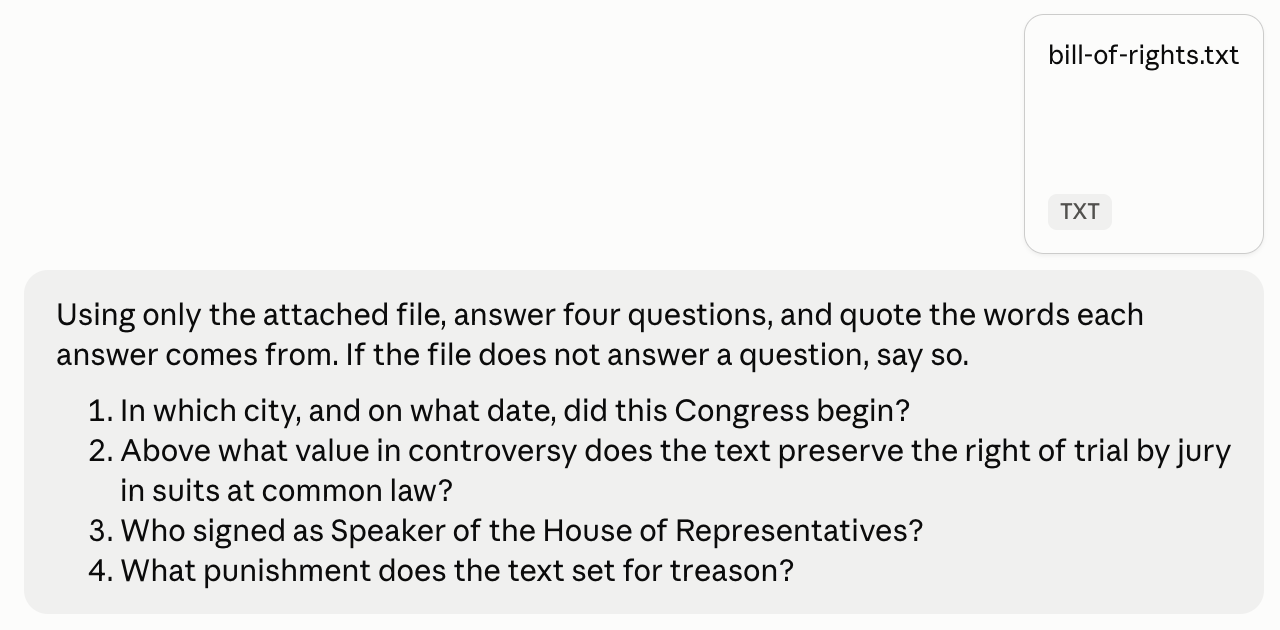
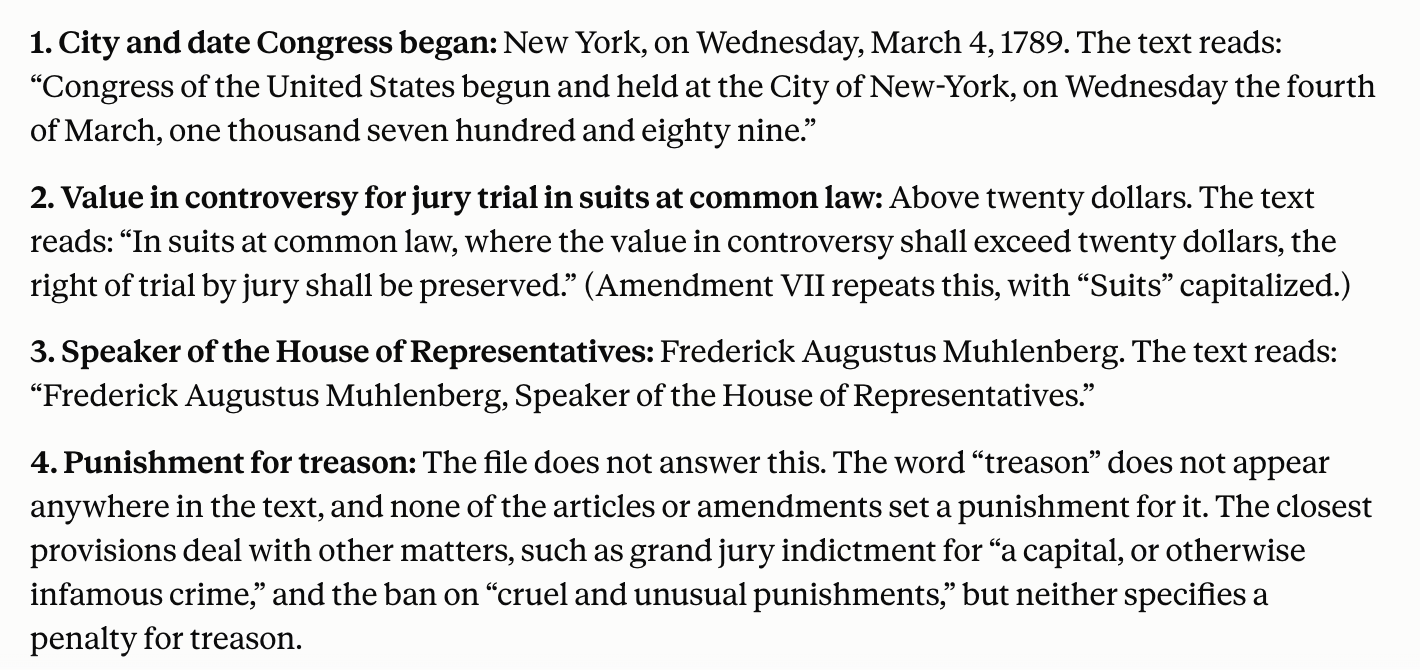
Claude
Pass 4 of 4
All four right (New-York, March 4, 1789; twenty dollars; Muhlenberg; not in the file), each of the first three with a quote found word for word in the file.
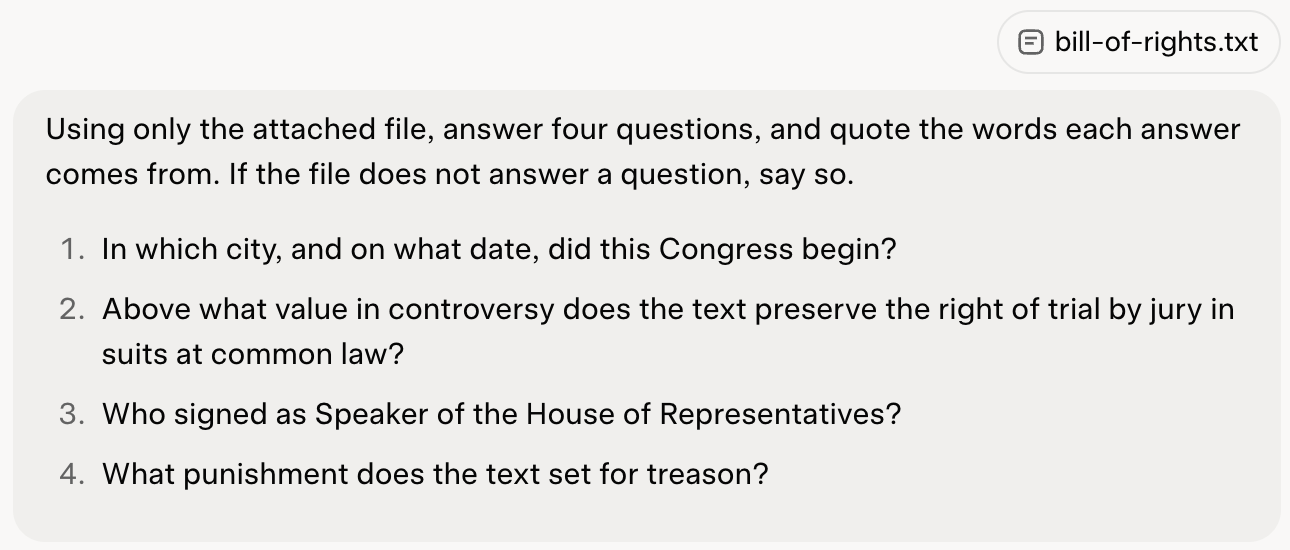
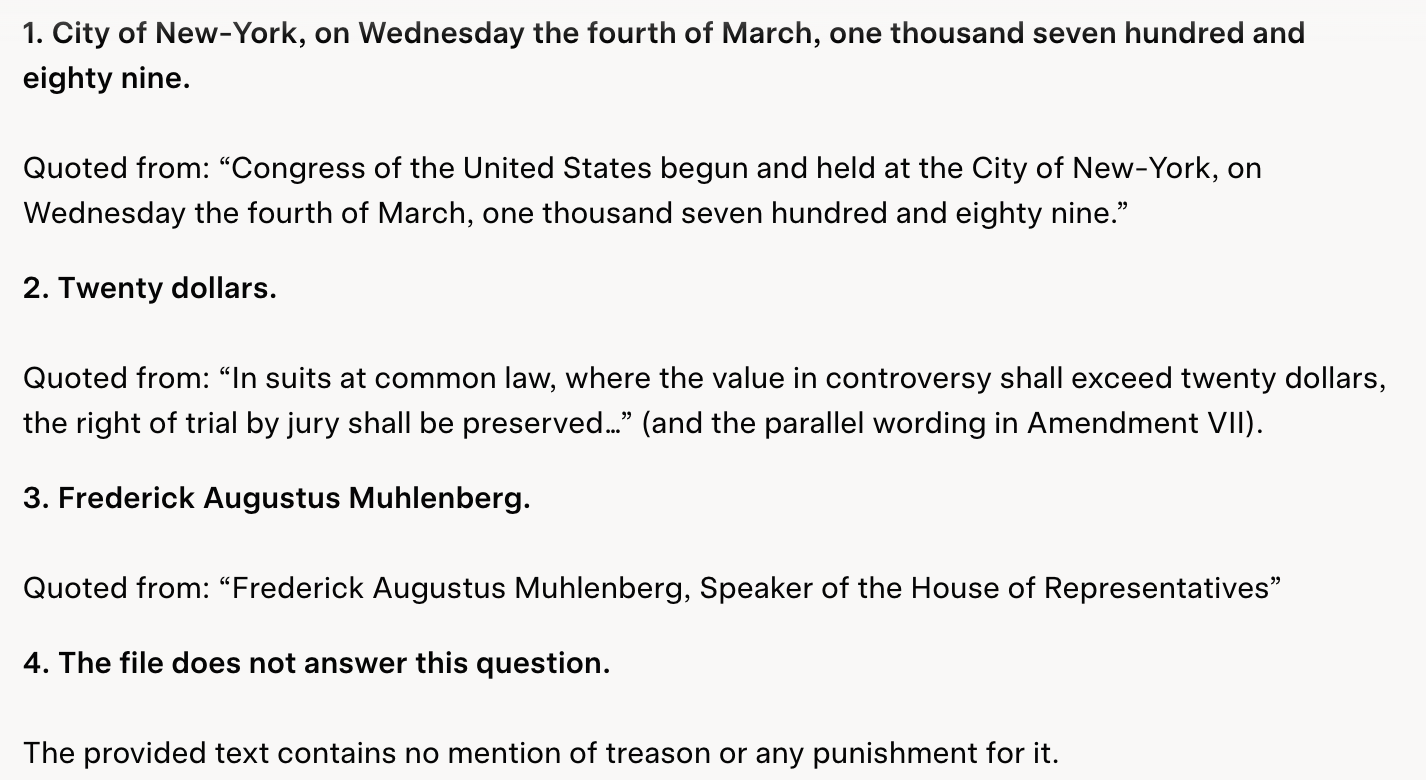
Grok
Pass 4 of 4
All four right (New-York, March 4, 1789; twenty dollars; Muhlenberg; not in the file), each of the first three with a quote found in the file.
Run signed in to both tools: a Claude Incognito chat (no memory; custom instructions empty) and a Grok private chat in Fast mode on Grok's free plan (custom instructions empty). Claude ran on a Max account with Sonnet 5.5 selected, a model the Free plan offers, Medium effort. Each prompt was sent once. Each tool got bill-of-rights.txt through its own upload button, and each quote was searched for in the file.
Test 2: Find the latest CPI figure with an official source (timed)
The task
Send this prompt in a new chat:
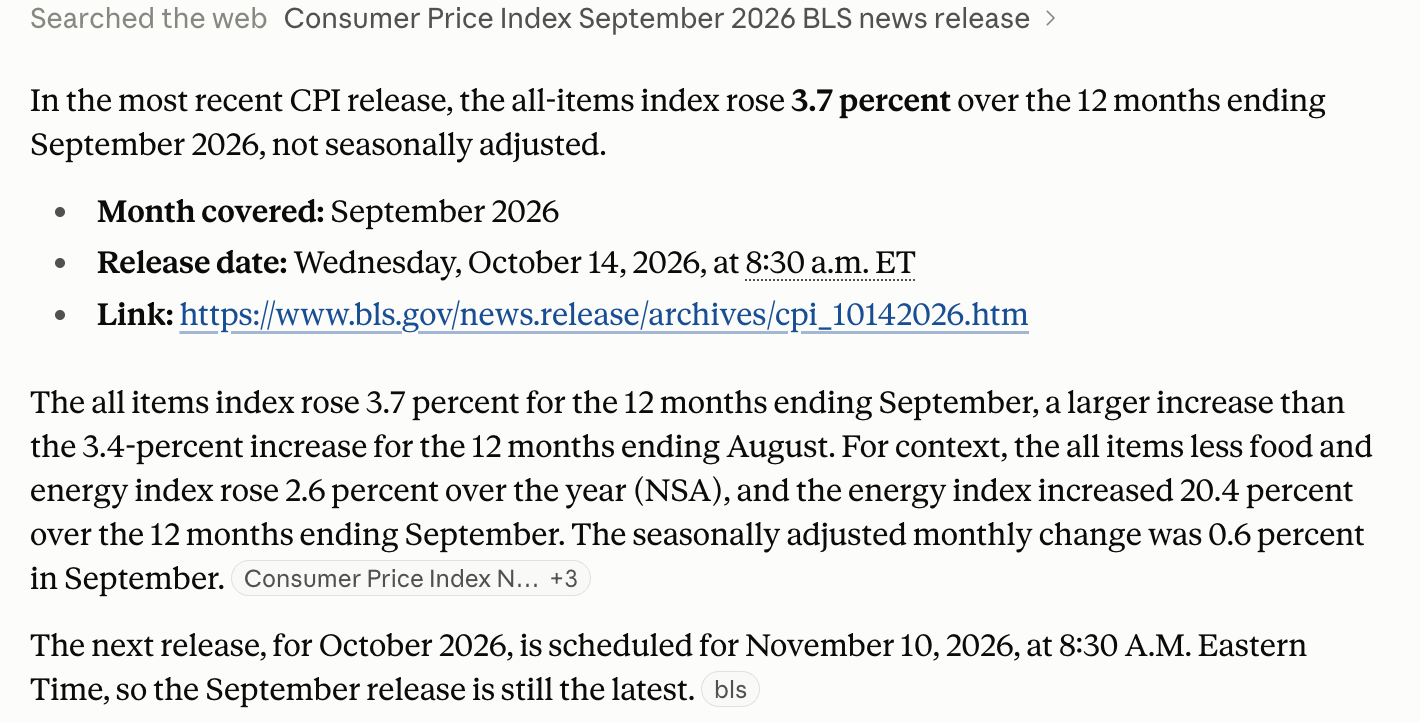
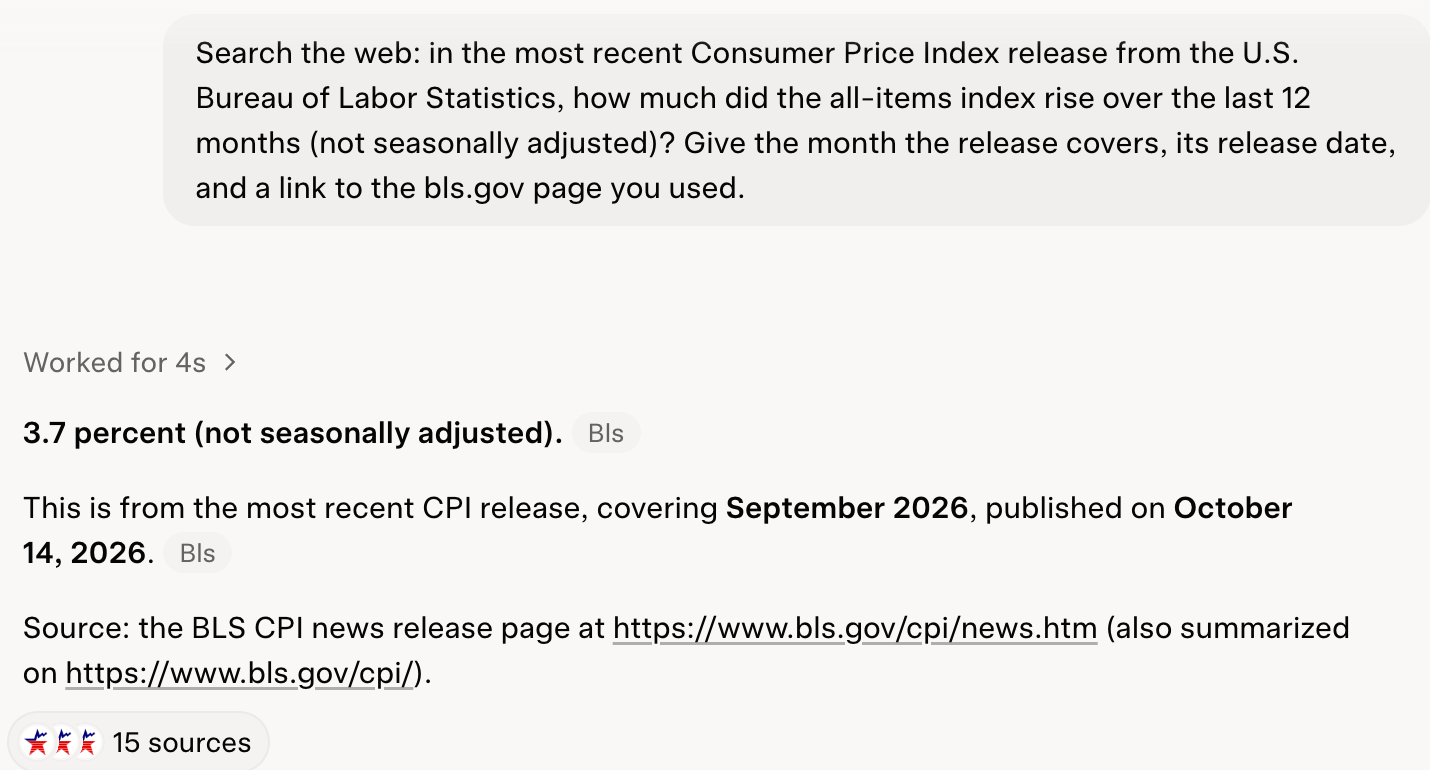
Search the web: in the most recent Consumer Price Index release from the U.S. Bureau of Labor Statistics, how much did the all-items index rise over the last 12 months (not seasonally adjusted)? Give the month the release covers, its release date, and a link to the bls.gov page you used.
How we judged it
On 2026-10-19 the CPI page at bls.gov showed the September 2026 release of October 14, 2026: all items up 3.7% over 12 months. The next release is due November 10, 2026, so check the page on the day of the test.
Pass: the latest release's month, date and 12-month figure, and a working bls.gov link.
Partial: the right figure, but the month or date missing or wrong, or no bls.gov link.
Fail: an older or wrong figure presented as the latest, or no figure.
The time runs from sending the prompt until the answer stops appearing.
Claude
Pass 8 s
3.7% over 12 months, September 2026, released October 14, 2026, linking the bls.gov release, which states all three.
Grok: Winner
Pass 7 s
3.7% over 12 months, September 2026, released October 14, 2026, linking the bls.gov CPI news release page, which states all three.
Run signed in to both tools: a Claude Incognito chat (no memory; custom instructions empty) and a Grok private chat in Fast mode on Grok's free plan (custom instructions empty). Claude ran on a Max account with Sonnet 5.5 selected, a model the Free plan offers, Medium effort. Each prompt was sent once. Every link was opened and checked. Times run from pressing Enter until the answer stopped changing, measured in the browser and rounded to the nearest second. Grok's first try ended with a High Demand message after about three minutes; its timed run is a fresh chat soon after.
Test 3: Find and fix the bug in a leap-year function
The task
Send this prompt in a new chat, with the code exactly as written:
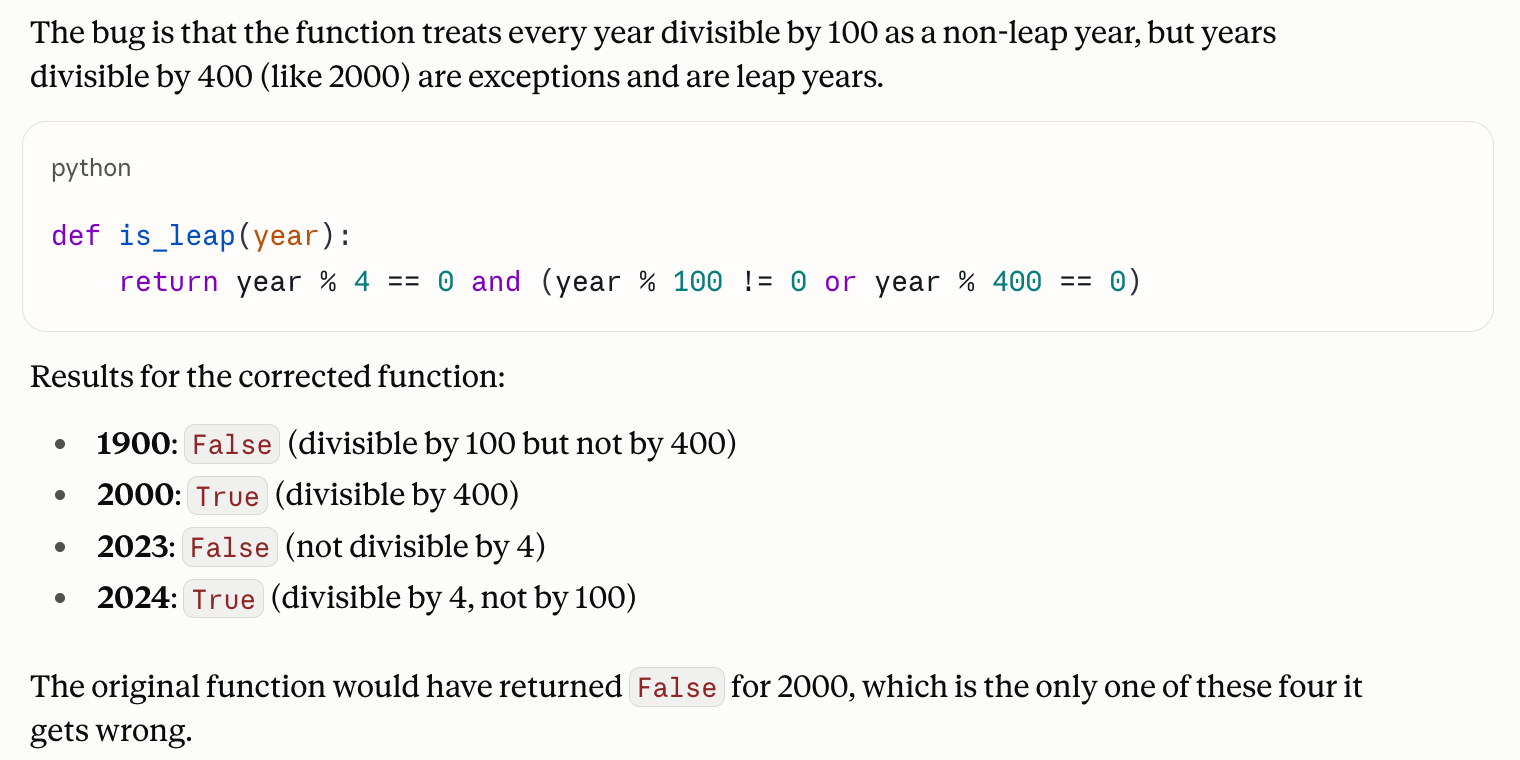
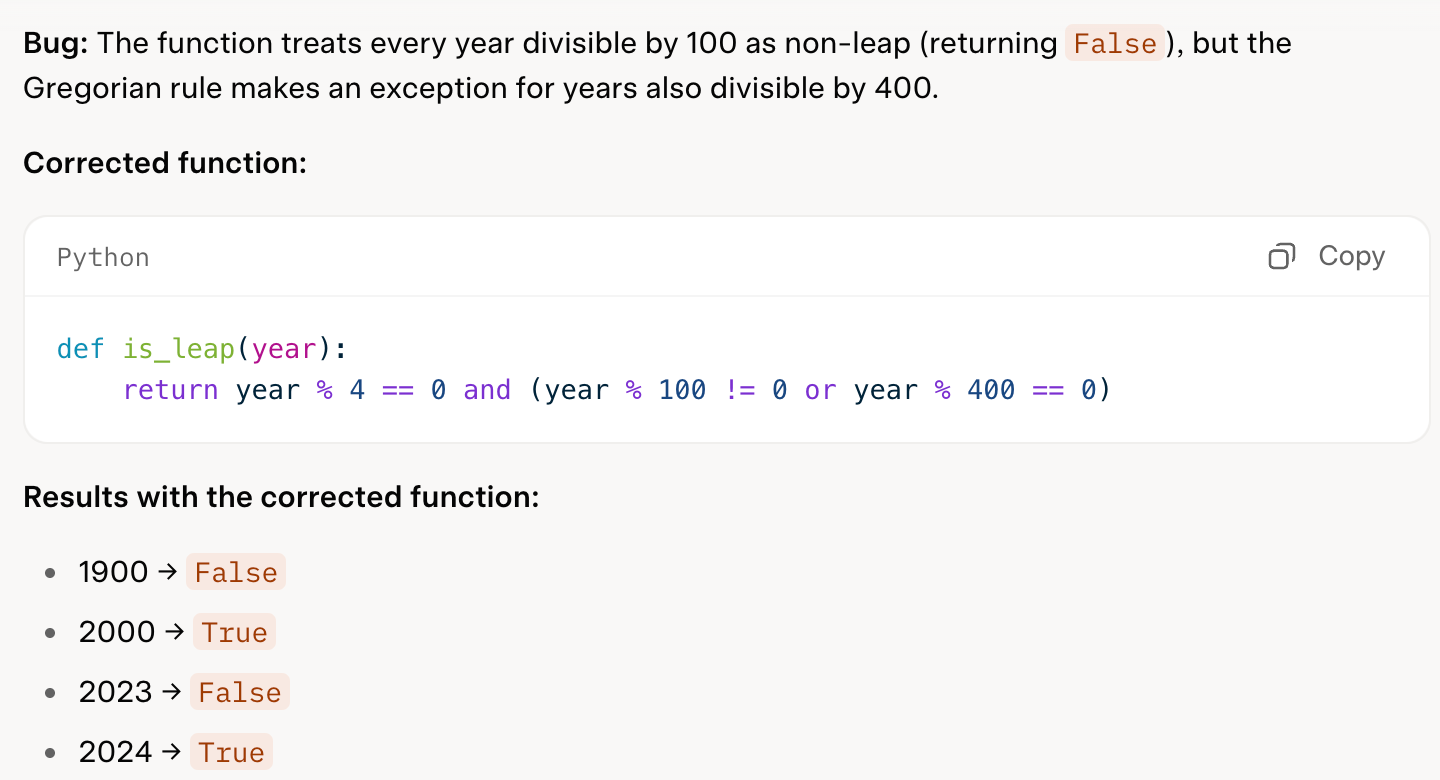
This Python function should return True for leap years in the Gregorian calendar, but it gives a wrong answer for some years. Explain the bug in one or two sentences, give the corrected function, and say what the corrected function returns for 1900, 2000, 2023 and 2024.
def is_leap(year): if year % 4 == 0: if year % 100 == 0: return False return True return False
How we judged it
The bug: years divisible by 100 count as common years even when they are also divisible by 400, so 2000 comes out False. The corrected function returns False, True, False and True for 1900, 2000, 2023 and 2024.
Pass: the bug explained, a corrected function that gives those four results, and the four results stated.
Partial: a working fix, but the explanation wrong or missing, or one stated result wrong.
Fail: no working fix, or a fix that gets one of the four years wrong.
Claude
Pass
Named the missing 400 rule, gave a one-line fix and stated False, True, False, True; the fix prints [False, True, False, True] in Python.
Grok
Pass
Named the missing 400 rule, gave a one-line fix and stated False, True, False, True; the fix prints [False, True, False, True] in Python.
Run signed in to both tools: a Claude Incognito chat (no memory; custom instructions empty) and a Grok private chat in Fast mode on Grok's free plan (custom instructions empty). Claude ran on a Max account with Sonnet 5.5 selected, a model the Free plan offers, Medium effort. Each prompt was sent once. Both tools gave the same one-line fix, which was run in Python 3 and printed [False, True, False, True]. Grok's first try ended with a High Demand message; its result is a fresh chat.
Test 4: Rewrite a lease clause in plain English
The task
Send this prompt in a new chat:
Rewrite this clause from a FICTIONAL lease in plain English for the tenant, as bullet points of at most 80 words in all. Keep every amount and deadline. Do not add advice or anything that is not in the clause.
The Tenant shall remit the monthly rent of $1,450 on or before the first (1st) day of each calendar month. Any payment received after the fifth (5th) day of the month shall incur a late charge of fifty dollars ($50.00). The Tenant shall furnish the Landlord with not less than thirty (30) days' written notice prior to vacating the Premises. The security deposit of $1,450 shall be returned within twenty-one (21) days after the Tenant vacates, less any lawful deductions.
How we judged it
The clause holds four points: rent of $1,450 due by the 1st; a $50 late fee for payment after the 5th; at least 30 days' written notice before moving out; the $1,450 deposit back within 21 days of moving out, minus lawful deductions.
Pass: all four points with every amount and deadline right, as bullet points of 80 words or fewer, with nothing added.
Partial: every amount right, but one point vague or missing, or over 80 words.
Fail: an amount or deadline changed, two points missing, or advice or claims added.
Claude
Pass
Four bullets in 53 words with every amount and deadline right ($1,450 by the 1st, $50 after the 5th, 30 days, 21 days) and nothing added.
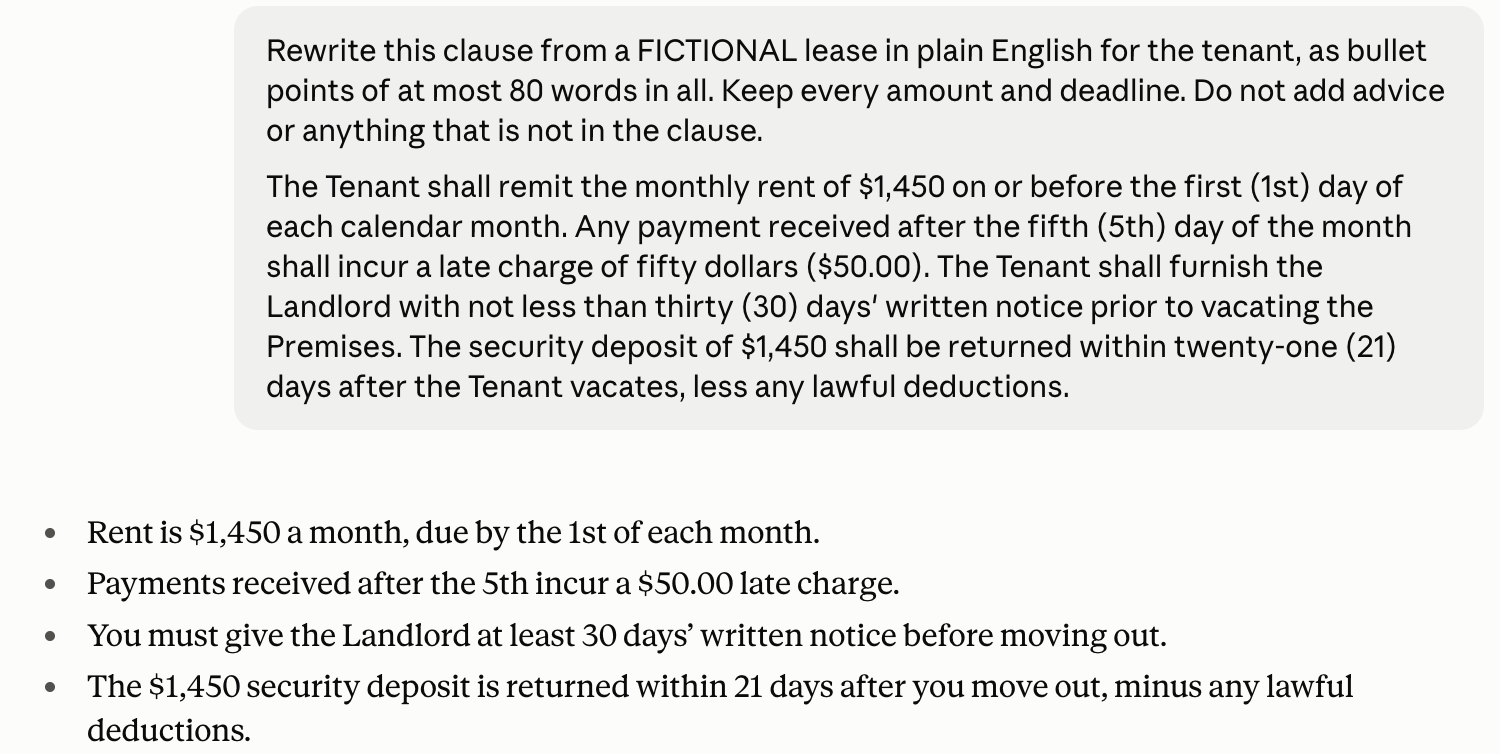
Grok
Pass
Four bullets in 48 words with every amount and deadline right ($1,450 by the 1st, $50 after the 5th, 30 days, 21 days) and nothing added.
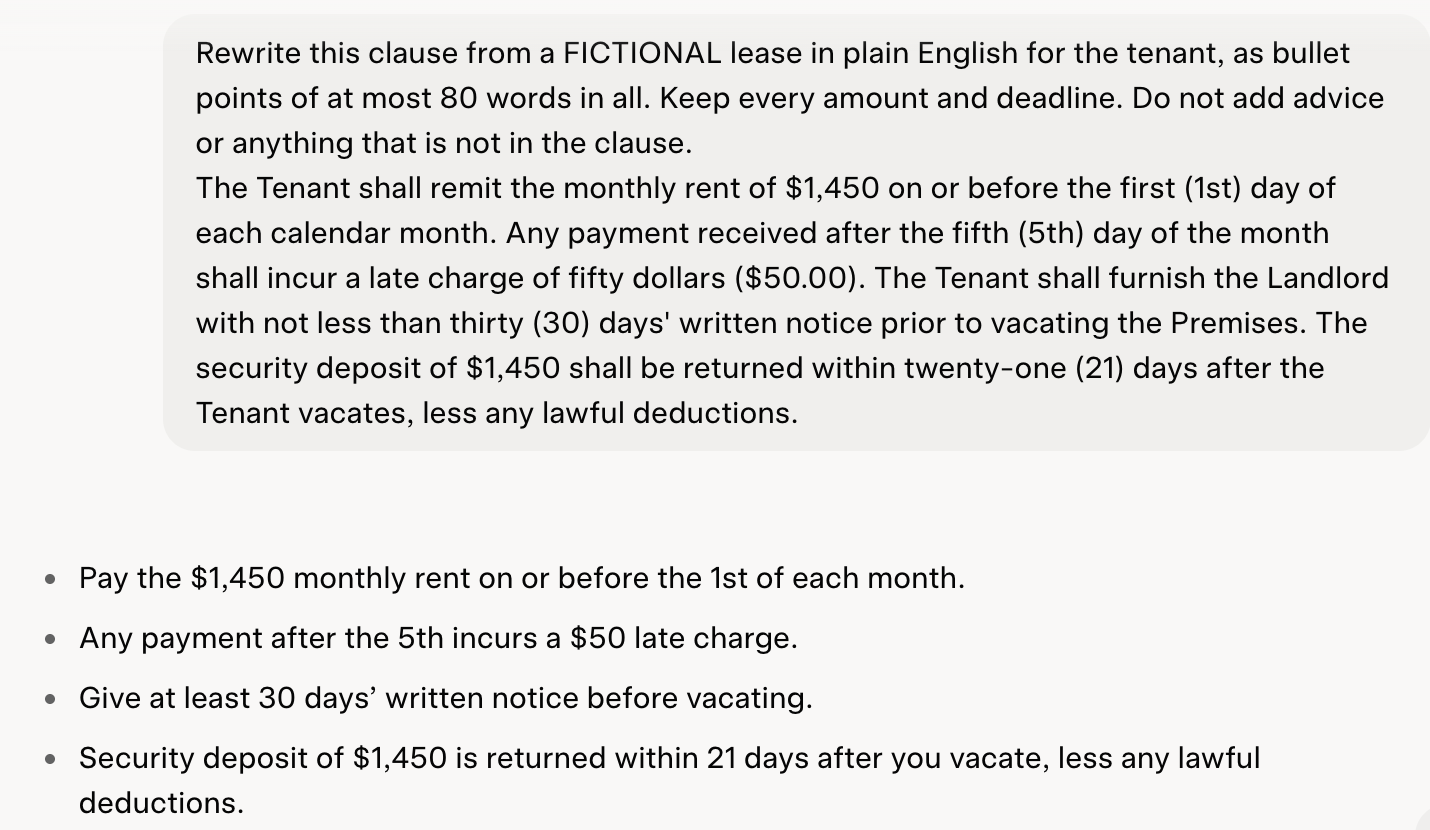
Run signed in to both tools: a Claude Incognito chat (no memory; custom instructions empty) and a Grok private chat in Fast mode on Grok's free plan (custom instructions empty). Claude ran on a Max account with Sonnet 5.5 selected, a model the Free plan offers, Medium effort. Each prompt was sent once. The rewrites were counted at 53 words (Claude) and 48 words (Grok).
Our verdict
Decide by what you want the assistant to keep up with and to make.
Grok suits people who follow live news and want pictures or video. It searches X and the web in real time with live citations, and Grok Imagine creates images even on the free plan. The first paid step is cheaper: Plus is $8 a month, and every individual plan also has a yearly price, from $80 for Plus to $2,000 for Ultra. Video generation and Grok Bot start at Premium ($30), which adds X Premium+ benefits. The catches: generated images and videos carry a Grok watermark you cannot switch off, and usage is a weekly pool given as multiples of Plus, with no message counts on the pricing page.
Claude suits long reading, writing and coding sessions. A single file can be 500 MB (150 MB for most files on Grok), PDFs can run to 1,000 pages, and Claude Code comes with every paid plan, from Pro at $20 a month or $200 a year. It builds diagrams and charts but does not generate images, the free plan has no Opus models, and Max ($100 or $200) is billed monthly only.
Team seats start lower on Claude: $25 a month, or $20 billed annually, against $30 for Grok Teams.
Choose Claude if
You mostly work with long documents, research or code. Claude takes files of up to 500 MB, up to 20 per chat, and PDFs of up to 1,000 pages, and every paid plan includes Claude Code. Pro costs $20 a month or $200 a year. It also fits a team of 2 to 150 people: Standard seats cost $20 a month billed annually, and Team content is not used for model training by default. Look elsewhere if you need image generation.
Choose Grok if
You want an assistant that keeps up with X and the news and also makes pictures and video. Grok searches X and the web in real time with live citations, and Grok Imagine creates images even on the free plan. Plus costs $8 a month or $80 a year; Premium, at $30 a month or $300 a year, adds video generation, Grok Bot and X Premium+ benefits. Since October 12, 2026, new self-serve customers buy Grok through The X Subscription, which also covers Cursor, the AI code editor.
Frequently asked questions
Is Claude or Grok cheaper?
Grok has the cheaper first paid step: Plus costs $8 a month or $80 a year, against $20 a month or $200 a year for Claude Pro. At the top end the monthly prices match: Grok Super and Ultra cost $100 and $200 a month, with 15 and 50 times Plus's usage, and Claude Max costs $100 or $200 a month for 5 or 20 times Pro's usage. Grok also sells those tiers yearly ($1,000 and $2,000), while Claude Max is billed monthly only. Both assistants have a free plan.
Can Claude create images like Grok?
No. Anthropic says Claude does not generate photos or illustrations the way image-generation tools do; it can build diagrams and charts with HTML and SVG instead. Grok creates images with Grok Imagine, with limits on the free plan, and video generation needs Premium ($30 a month) or higher. xAI adds a Grok watermark to generated images and videos, and there is no setting to remove it.
Which takes bigger files and more of them?
Claude allows bigger files: up to 500 MB each, up to 20 per chat, and PDFs of up to 1,000 pages (text only beyond 100 pages). Grok takes more at once: about 100 files in one go on the web (20 on Android), with documents, images, code and audio limited to 150 MB each; xAI says limits can vary by platform or plan.
Do Claude and Grok use my chats to train their models?
Both let you opt out. Anthropic offers a model-training opt-out on Claude's individual plans and does not use Team or Enterprise content for training by default. In Grok, you can stop new chats being used for training with the Improve the Model setting, or use Private Chat, though feedback you choose to send may still be used; xAI says business content is not used. In some regions outside the EU and UK, Grok use without signing in cannot be opted out.
Do Claude and Grok have plans for teams?
Yes. Claude Team costs $25 per Standard seat a month, or $20 billed annually, for 2 to 150 people; Premium seats cost $125, or $100 billed annually, with five times the Standard usage. Claude Enterprise is $20 per seat a month billed annually, with a 20-seat minimum, plus usage at API rates. Grok Teams starts at $30 per user a month, with Premium ($30), Super ($100) and Ultra ($200) seats you can mix, SAML or OIDC single sign-on and central billing. Grok Enterprise is priced by sales and adds pooled usage, invoice billing, SCIM and audit logs.
Compare with others
- ChatGPT vs Claude
- ChatGPT vs Grok
- Claude vs Gemini
- Claude vs Microsoft Copilot
- Claude vs Perplexity
- Gemini vs Grok
More about: Claude · Grok · Best AI chat assistants