
Claude vs Perplexity: Which is better in 2026?
Pick by the job you bring to it most often.
Tested hands-on: 4 tests on a MacBook Pro (M1 Pro), October 21, 2026. How we tested
Some links on this page are affiliate links. If you buy through them we may earn a commission at no extra cost to you. This never affects our verdicts.
Quick answer
- Choose Claude if: You want an assistant for long documents, writing and code more than a search engine.
- Choose Perplexity if: You want answers you can check.
- Price at a glance: Claude: Free plan; paid from $20/mo · Perplexity: Free plan; paid from $20/mo
At a glance
 Claude |  Perplexity | |
|---|---|---|
| Free plan | Yes | Yes |
| Paid plans | From $20/mo | From $20/mo |
| Our tests | Won 1 of 43 ties | Won 0 of 43 ties |
| Best for | Writers, analysts and developers who work with long documents or code and do not need image generation. | People who use an AI assistant mainly for research and want every answer tied to cited web sources, with a choice of AI models on a paid plan. |
Claude and Perplexity both answer questions in plain language, but they start from different places. Claude, Anthropic's assistant since March 2023, is built for writing, analysis and coding, and can search the web on every plan. Perplexity, an answer engine first released in December 2022, searches the web for each question and ties its answers to inline citations. Their main paid plans cost the same, $20 a month or $200 a year, so the real differences are file limits, images, model choice, team prices and training defaults. This comparison sets them side by side using each vendor's own pricing and help pages, as of October 2026.
Pricing
| Plan | Monthly | Yearly (12-month total) |
|---|---|---|
| Claude | ||
| FreeSonnet and Haiku models; up to 5 projects | Free Free plan | |
| Pro$17/month with annual billing ($200 billed up front) | $20/mo | $200/yr ($16.67/mo) |
| Max 5xBilled monthly only; includes $100/month in API credits | $100/mo | no yearly price |
| Max 20xBilled monthly only; includes $200/month in API credits | $200/mo | no yearly price |
| Team (Standard seat)Per user/month; $20 per user/month billed annually; 2 to 150 seats | $25/mo | $240/yr ($20/mo) |
| Team (Premium seat)Per user/month; $100 per user/month billed annually; 5x Standard usage | $125/mo | $1,200/yr ($100/mo) |
| EnterprisePer user, billed annually ($20/seat/month), 20-seat minimum, plus usage at API rates | no monthly price | $240/yr, billed yearly ($20/mo) |
| Perplexity | ||
| FreePractically unlimited basic searches; 3 Pro Searches a day and 1 Research query a month; limited uploads | Free Free plan | |
| Pro$17/month when billed annually ($200 a year); one-time 4,000 Computer credit bonus for new subscribers | $20/mo | $200/yr ($16.67/mo) |
| MaxAnnual billing on the web app only ($167/month when billed annually); 10,000 Computer credits a month | $200/mo | $2,000/yr ($166.67/mo) |
| Enterprise ProPer seat; $400 per seat a year ($34/month when billed annually); no self-serve trial | $40/mo | $400/yr ($33.33/mo) |
| Enterprise MaxPer seat; $3,250 per seat a year ($271/month when billed annually); seats can be mixed with Enterprise Pro | $325/mo | $3,250/yr ($270.83/mo) |
Prices checked on .
Features compared
| Feature | Claude | Perplexity |
|---|---|---|
| Free tier | Yes · Sonnet and Haiku; web search, memory, 5 projects | Yes · Practically unlimited basic searches, 3 Pro Searches a day, limited uploads |
| File upload | Yes · Up to 20 files per chat, 500 MB each | Yes · Up to 40 MB per chat file (50 MB on Enterprise) and 100 MB per Project file; rolling weekly chat upload allowance on Free, Pro and Max |
| Web search | Yes · All plans | Yes · Real-time web search with inline citations; limited on Free |
| Image generation | No · Diagrams and charts only (HTML/SVG) | Yes · Pro, Max and Enterprise; Free, Pro and Max images are non-commercial only |
| Voice mode | Yes · All plans | Yes · Voice conversations in the iOS app; voice assistant on Android |
| Memory/projects | Yes · Memory on all plans; Free up to 5 projects | Yes · Memory across chats; unlimited Projects, up to 5 contributors each (9,999 if the owner is in an organization or is a verified student or educator) |
| API access | Add-on · Claude API, pay as you go; Max and Team include credits | Add-on · Perplexity API, pay as you go; no subscription needed |
| Mobile apps | Yes · iOS and Android | Yes · iOS and Android |
| Team plan | Yes · Team from $20/seat/mo billed yearly ($25 monthly), 2-150 seats | Yes · Enterprise Pro $40/seat/mo or $400/seat/yr; Enterprise Max $325/seat/mo or $3,250/seat/yr |
| Training opt-out | Yes · Opt-out on individual plans; no training on Team content by default | Yes · Toggle on Free, Pro and Max (on by default); Enterprise data never used |
How we tested
We gave Claude and Perplexity the same 4 tasks on the same MacBook Pro (M1 Pro). Each test below lists the task, how we judged it, both results and screenshots; select a screenshot to see it at full size.
- Device
- MacBook Pro (M1 Pro) · macOS 26.6.2 · Chrome 155
- Tested
- October 21, 2026
- Plans used
- Claude: Max, using Sonnet 5.5 (a Free-plan model), Medium effort · Perplexity: Free
- App versions
- Claude: claude.ai, Incognito chat (searched the web), claude.ai, Incognito chat · Perplexity: perplexity.ai, Search (default)
| Test | Claude | Perplexity | Winner |
|---|---|---|---|
| Answer four factual questions with an official source for each | Pass4 of 4 | Pass4 of 4 | Tie |
| Answer from an attached file only, including a question it does not cover | Pass5 of 5 | Pass5 of 5 | Tie |
| Compare two courier prices in a table and find the break-even point | Pass | Pass | Tie |
| Explain compound interest simply, with a worked example (timed) | Pass3 s | Pass4 s | Claudeby Time to a finished answer |
| Tests won | 1 | 0 | 3 ties |
Test 1: Answer four factual questions with an official source for each
The task
Send this prompt in a new chat:
Answer these four questions. For each answer, give a link to an official U.S. government page (.gov) that states it.
- What is the U.S. federal minimum wage per hour, and since what date has it applied?
- On what date was Yellowstone established as a national park, and which president signed the law?
- On what date did the James Webb Space Telescope launch?
- In what year did the Library of Congress begin, and which president approved the act that started it?
How we judged it
The right answers are $7.25 an hour since July 24, 2009; March 1, 1872, signed by Ulysses S. Grant; December 25, 2021; and 1800, approved by John Adams.
Pass: all four answers right, each with a .gov link that opens and states it.
Partial: all four answers right, but one or two links are missing, broken, not on a .gov site or do not state the answer.
Fail: a wrong answer, or three or more answers without a supporting .gov link.
Claude
Pass 4 of 4
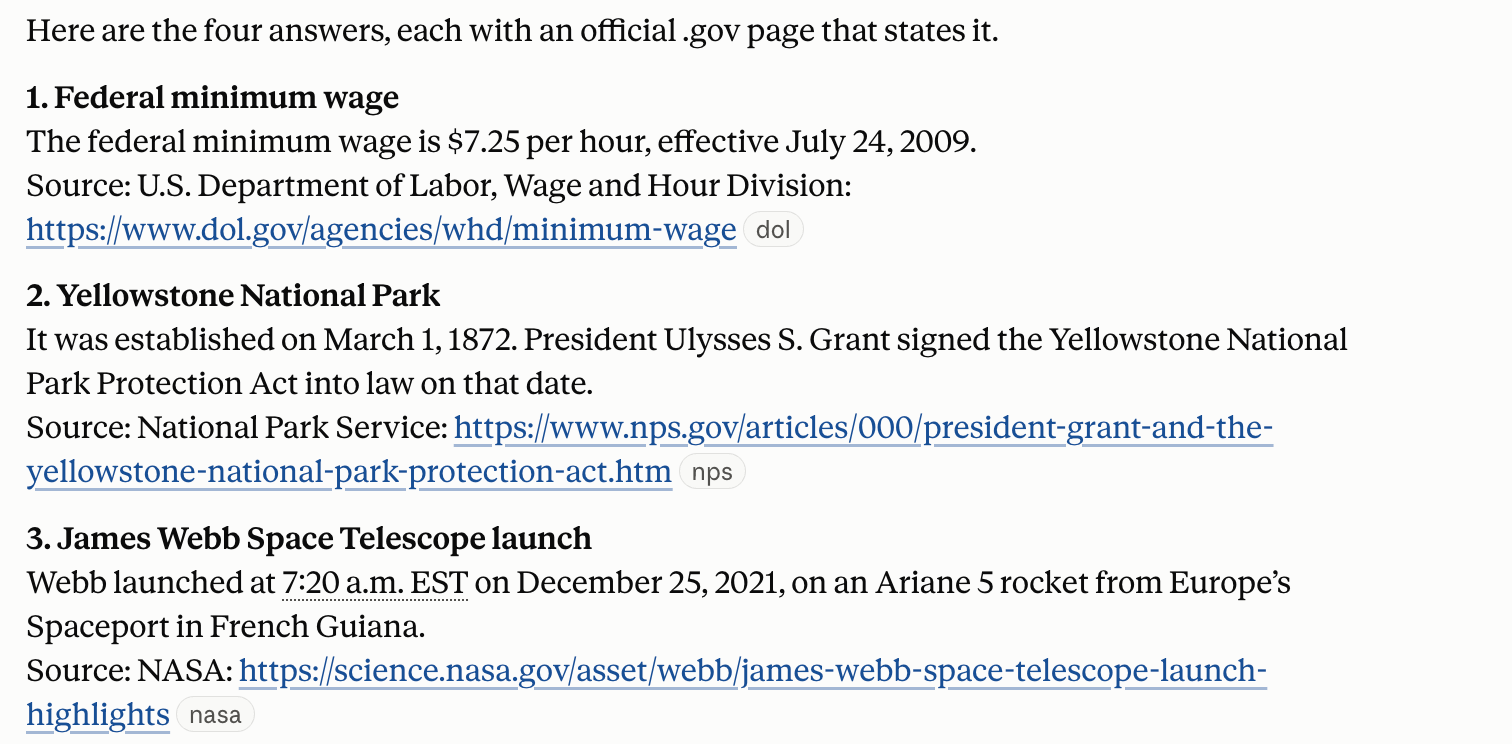
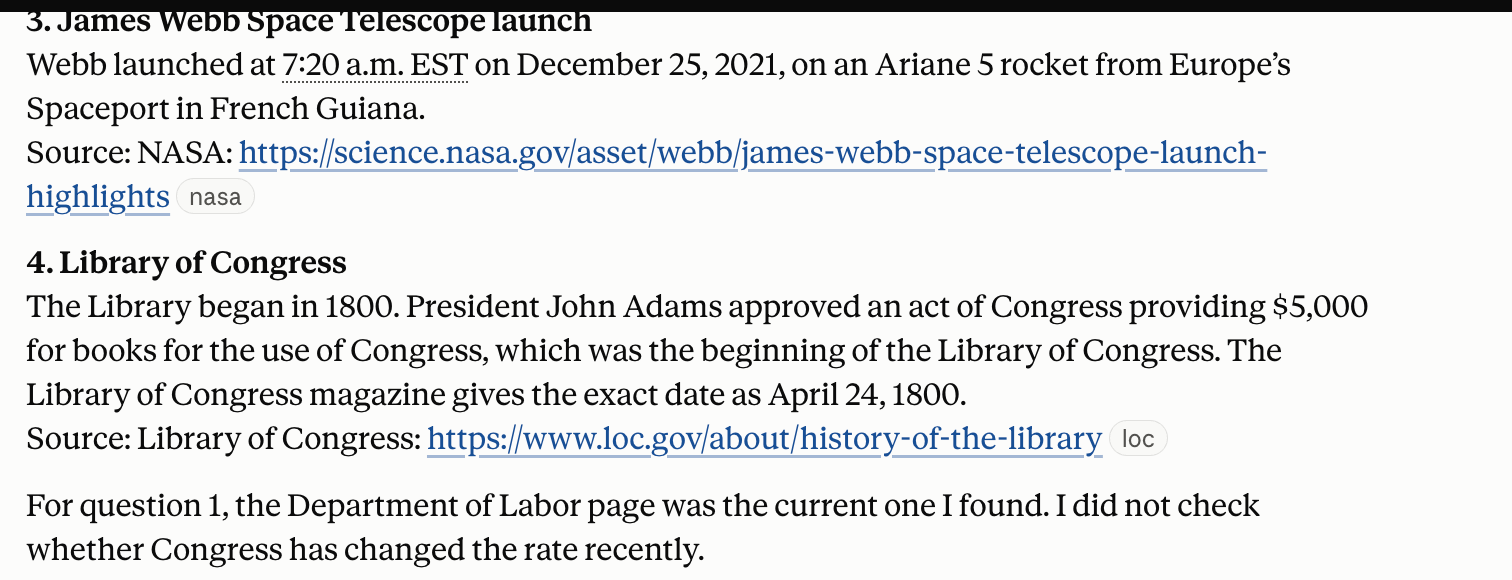
All four right ($7.25 since July 24, 2009; March 1, 1872, Grant; Dec 25, 2021; 1800, John Adams), each with a .gov page that states it.
Perplexity
Pass 4 of 4
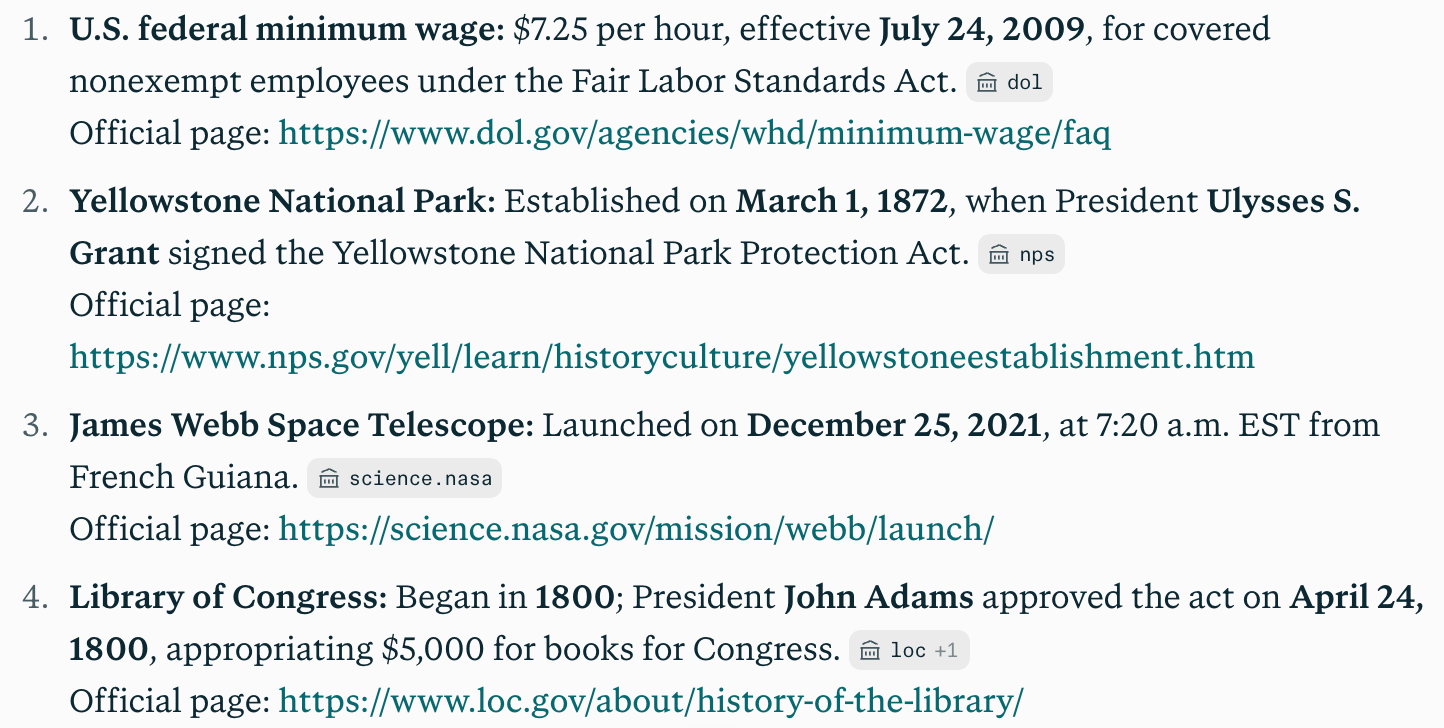
All four right ($7.25 since July 24, 2009; March 1, 1872, Grant; Dec 25, 2021; 1800, John Adams), each with a .gov page that states it.
Run signed in to both tools: a Claude Incognito chat (no memory; custom instructions empty) and a new Perplexity thread on its free plan with no custom instructions, each with default settings (both searched the web on their own). Claude ran on a Max account with Sonnet 5.5 selected, a model the Free plan offers. Each prompt was sent once. Every link was opened and checked for the fact.
Test 2: Answer from an attached file only, including a question it does not cover
The task
Save the FICTIONAL policy below as a plain-text file named fernhill-returns.txt, attach it to a new chat and send this prompt:
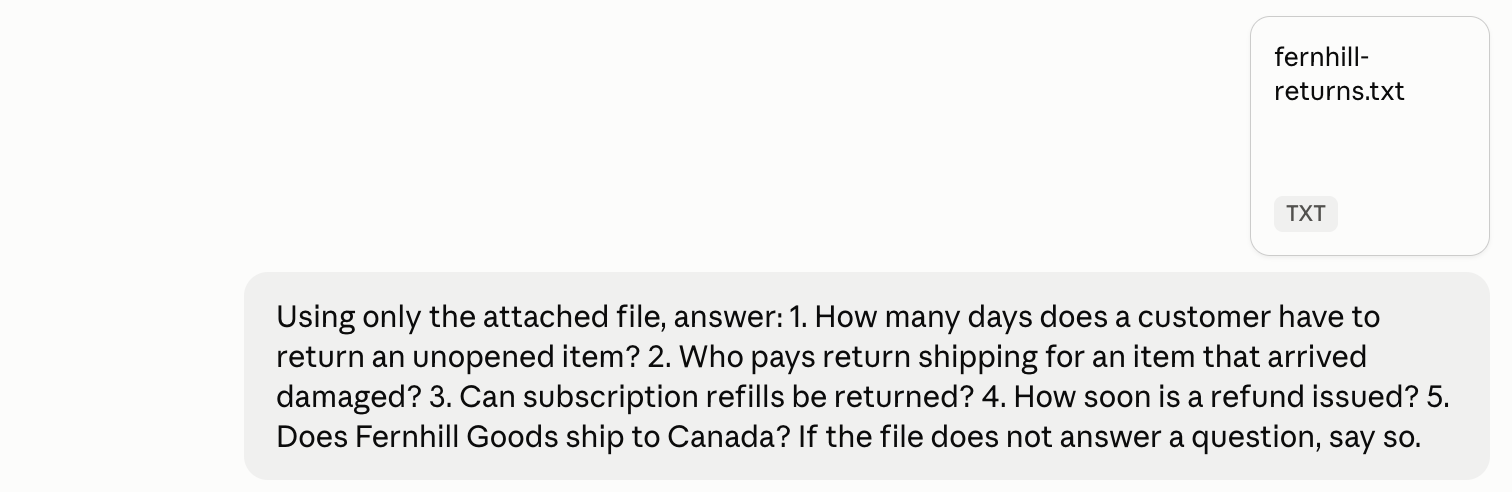
Using only the attached file, answer: 1. How many days does a customer have to return an unopened item? 2. Who pays return shipping for an item that arrived damaged? 3. Can subscription refills be returned? 4. How soon is a refund issued? 5. Does Fernhill Goods ship to Canada? If the file does not answer a question, say so.
The file's text:
Fernhill Goods returns policy. Unopened items can be returned within 30 days of delivery. We pay return shipping when an item arrives damaged; otherwise the customer pays it. Refills sent as part of a subscription cannot be returned, but a subscription can be paused at any time. Refunds go to the original payment method within 5 working days of the return reaching our warehouse.
How we judged it
The right answers are 30 days from delivery; Fernhill Goods; no (the subscription can be paused instead); within 5 working days of the return reaching the warehouse; and that the file does not say.
Pass: all five right, including saying the file does not cover shipping to Canada.
Partial: four right.
Fail: three or fewer right, or an answer taken from outside the file (for example a web page) presented as the policy.
Claude
Pass 5 of 5
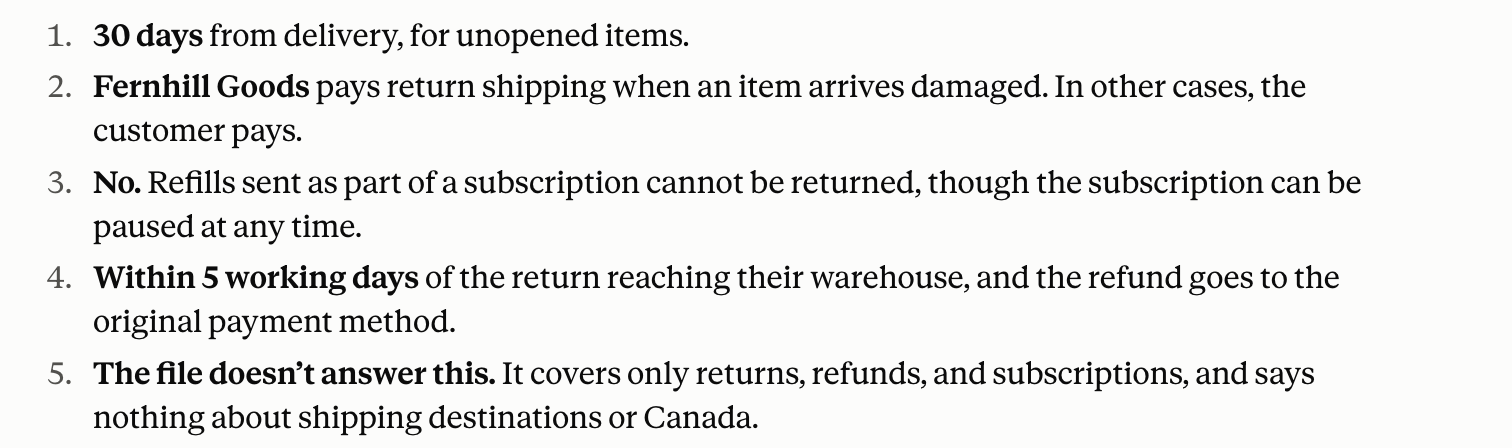
All five right: 30 days, Fernhill pays, no (pause instead), 5 working days, and the file does not cover shipping to Canada.
Perplexity
Pass 5 of 5
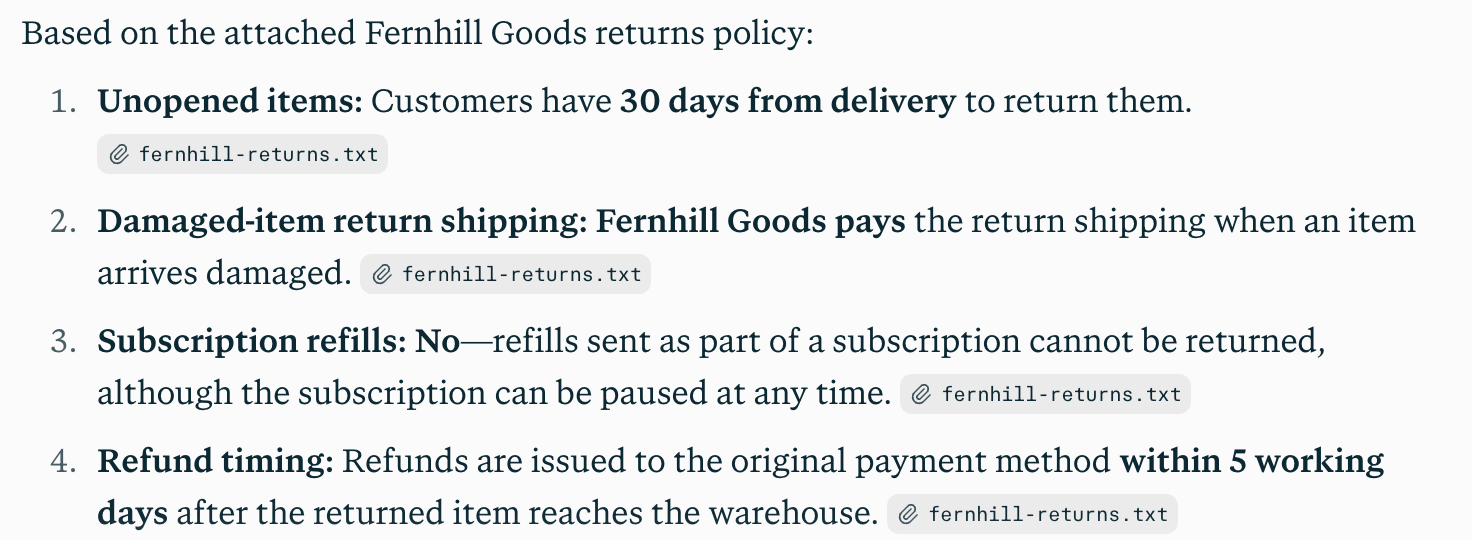
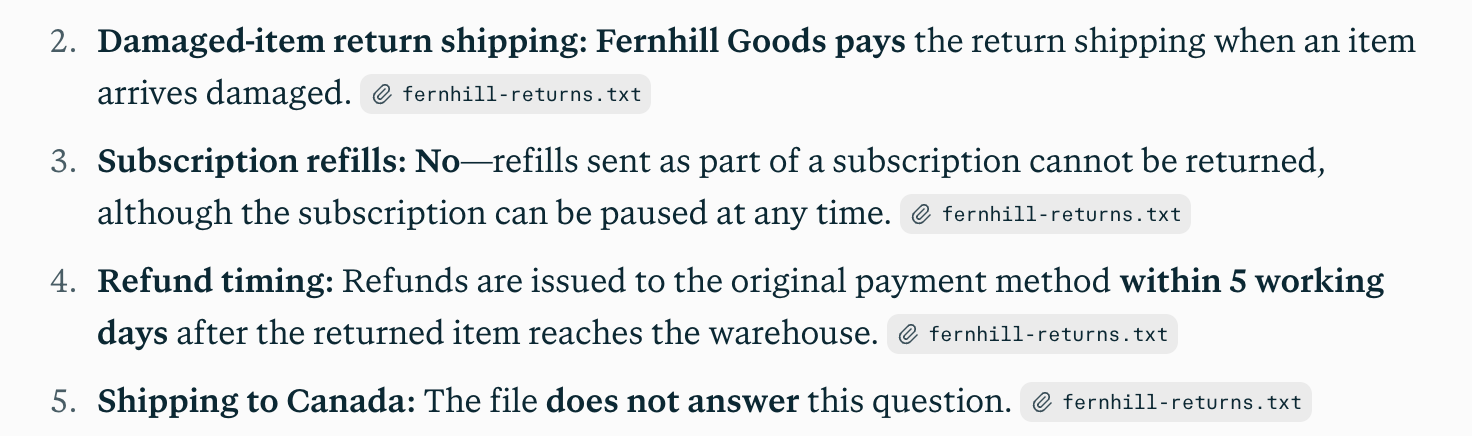
All five right, each citing only the attached file, including that the file does not cover shipping to Canada.
Run signed in to both tools: a Claude Incognito chat (no memory; custom instructions empty) and a new Perplexity thread on its free plan with no custom instructions, each with default settings (both searched the web on their own). Claude ran on a Max account with Sonnet 5.5 selected, a model the Free plan offers. Each prompt was sent once. Each tool got fernhill-returns.txt through its own upload button.
Test 3: Compare two courier prices in a table and find the break-even point
The task
Send this prompt in a new chat:
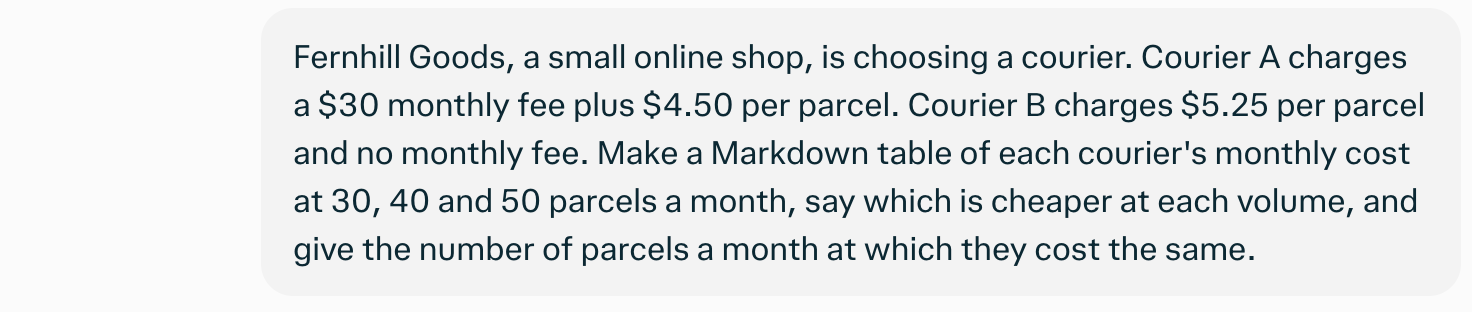
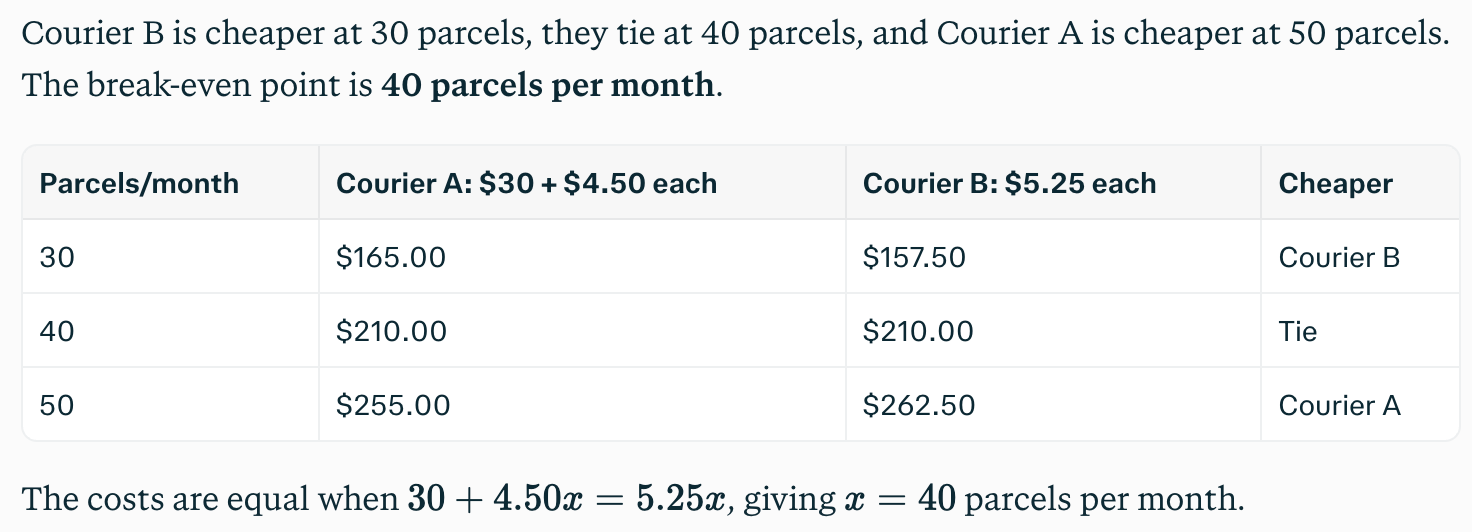
Fernhill Goods, a small online shop, is choosing a courier. Courier A charges a $30 monthly fee plus $4.50 per parcel. Courier B charges $5.25 per parcel and no monthly fee. Make a Markdown table of each courier's monthly cost at 30, 40 and 50 parcels a month, say which is cheaper at each volume, and give the number of parcels a month at which they cost the same.
How we judged it
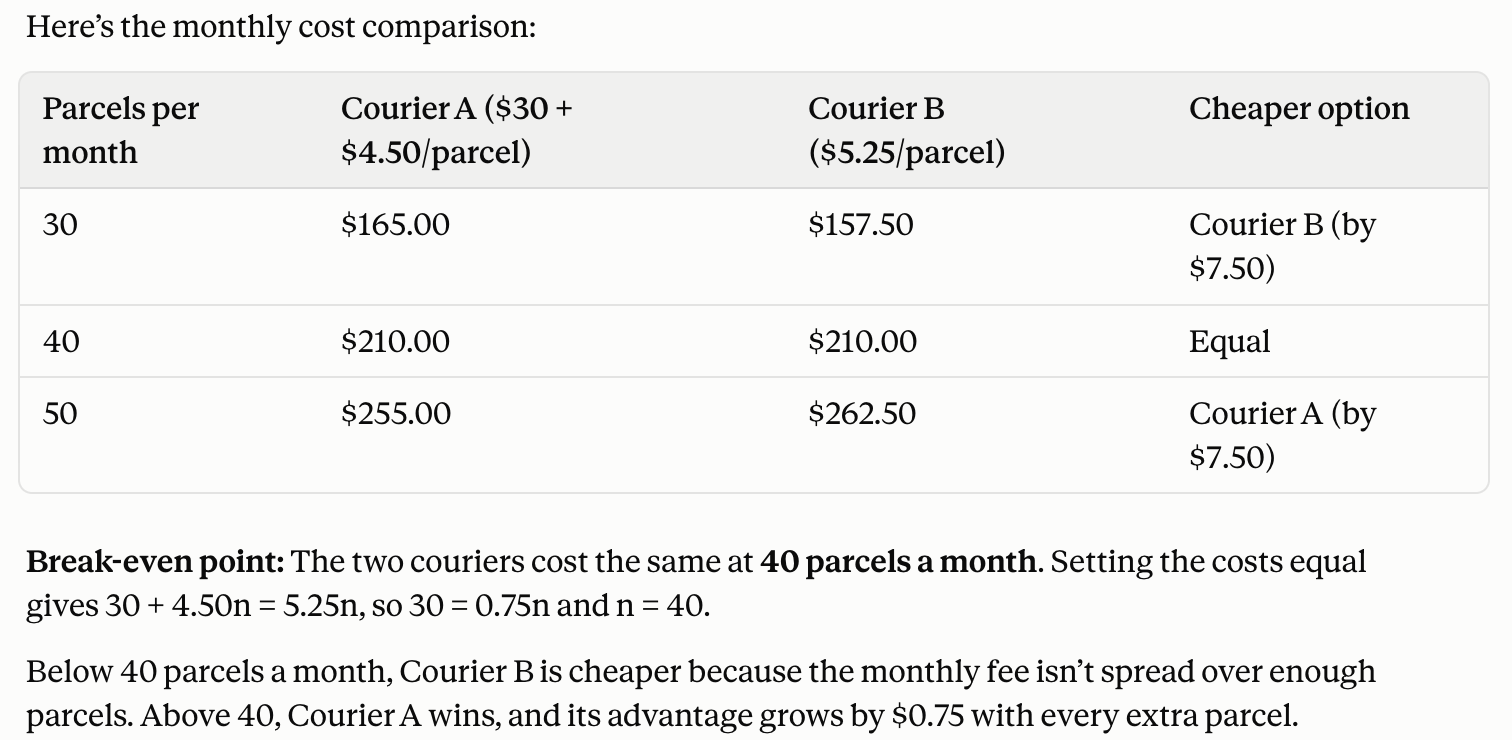
The right figures are: 30 parcels, A $165.00 and B $157.50 (B cheaper); 40 parcels, $210.00 each (the same); 50 parcels, A $255.00 and B $262.50 (A cheaper). They cost the same at 40 parcels a month.
Pass: all six costs, the cheaper courier at each volume and the break-even point right, in a table.
Partial: the break-even point right, but one cost or label wrong, or no table.
Fail: two or more mistakes, or a wrong break-even point.
Claude
Pass
A table with all six costs ($165.00/$157.50, $210.00 each, $255.00/$262.50), the cheaper courier at each volume and break-even at 40.

Perplexity
Pass
A table with all six costs ($165.00/$157.50, $210.00 each, $255.00/$262.50), the cheaper courier at each volume and break-even at 40.
Run signed in to both tools: a Claude Incognito chat (no memory; custom instructions empty) and a new Perplexity thread on its free plan with no custom instructions, each with default settings (both searched the web on their own). Claude ran on a Max account with Sonnet 5.5 selected, a model the Free plan offers. Each prompt was sent once.
Test 4: Explain compound interest simply, with a worked example (timed)
The task
Send this prompt in a new chat:
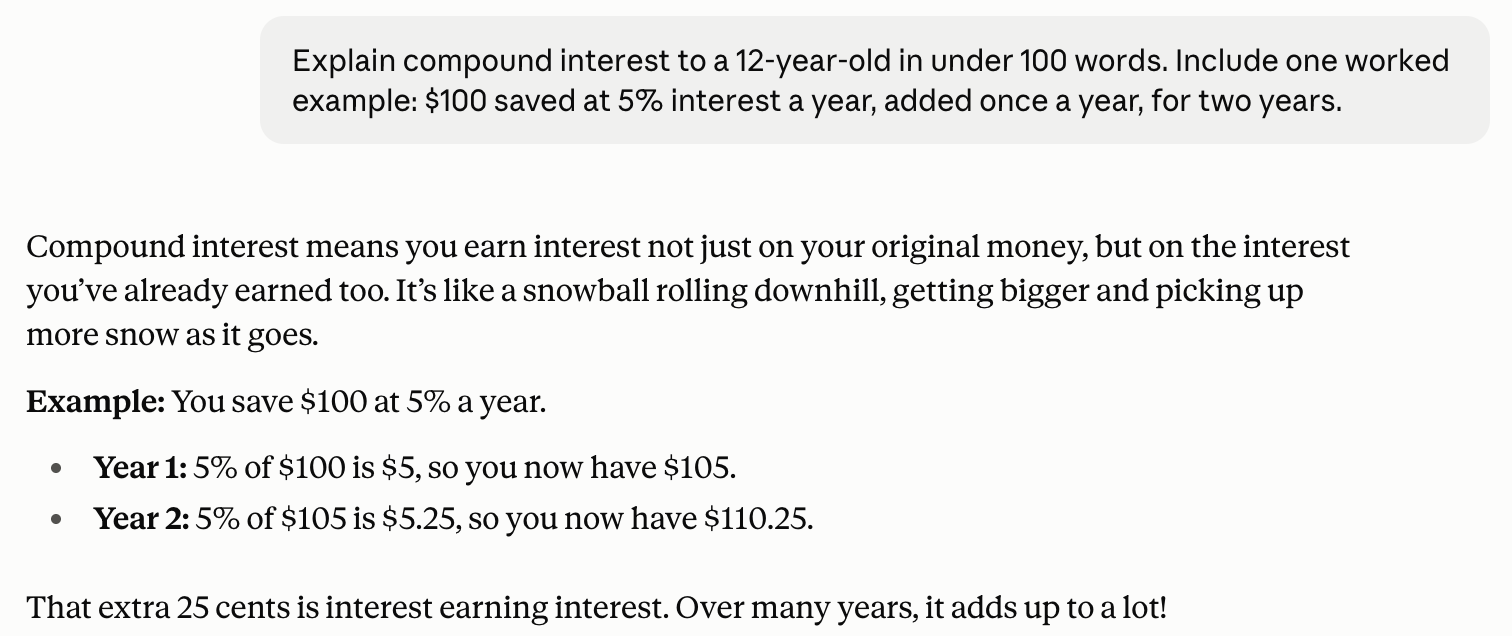
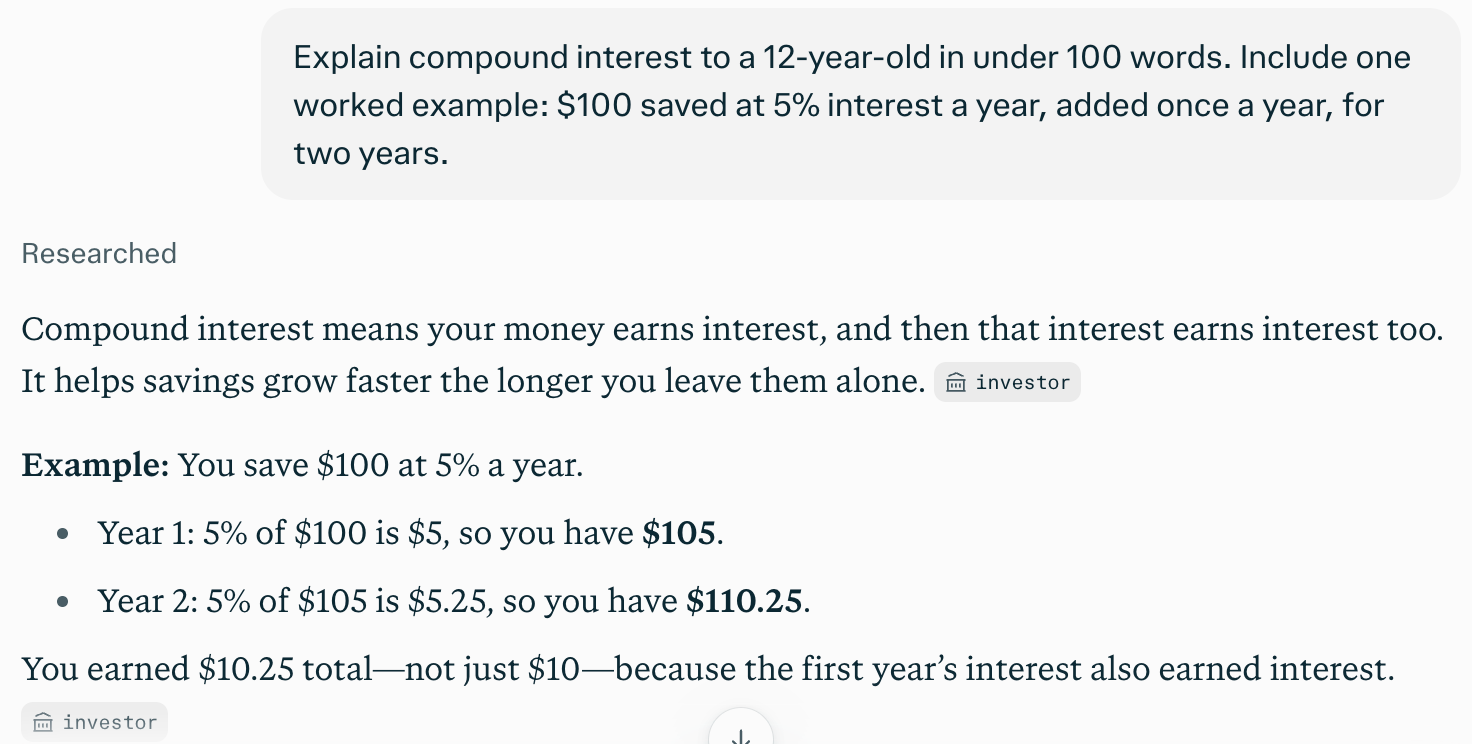
Explain compound interest to a 12-year-old in under 100 words. Include one worked example: $100 saved at 5% interest a year, added once a year, for two years.
How we judged it
The right figures are $105.00 after the first year and $110.25 after the second.
Pass: under 100 words, plain language, and both figures right.
Partial: the right final figure, but 100 words or more, no first-year figure, or a term left unexplained.
Fail: a wrong final figure (for example $110, which is simple interest) or no worked example.
The time is measured from sending the prompt until the answer stops appearing.
Claude: Winner
Pass 3 s
85 words in plain language (a snowball image), with $105.00 after year one and $110.25 after year two.
Perplexity
Pass 4 s
68 words in plain language, with $105.00 after year one and $110.25 after year two.
Run signed in to both tools: a Claude Incognito chat (no memory; custom instructions empty) and a new Perplexity thread on its free plan with no custom instructions, each with default settings (both searched the web on their own). Claude ran on a Max account with Sonnet 5.5 selected, a model the Free plan offers. Each prompt was sent once. Times run from pressing Enter until the answer stopped changing, measured in the browser and rounded to the nearest second.
Our verdict
Pick by the job you bring to it most often.
Perplexity suits research where you want to check every claim. Each answer comes with inline citations to its sources, and the free plan already gives practically unlimited basic searches plus 3 Pro Searches a day. Pro ($20 a month or $200 a year) lets you choose the AI model for each query, adds more Research queries and Perplexity Computer, an agent for multi-step tasks, and creates images and videos of up to 8 seconds. The trade-offs: chat uploads stop at 40 MB per file within a weekly allowance, images from personal plans are for non-commercial use only, and AI training is on by default on personal plans, with an opt-out that covers only data collected afterwards.
Claude suits long documents, careful writing and code. A chat takes up to 20 files of 500 MB each, every paid plan includes Claude Code, and Max 5x adds a $100 step between Pro and the $200 tier. It builds diagrams and charts but does not generate photos or illustrations, and its free plan has no Opus models.
For teams, Claude costs less: a Team Standard seat is $20 a month billed annually ($25 monthly), against $34 ($40 monthly) for Perplexity Enterprise Pro. Neither vendor trains on business-plan data by default.
Choose Claude if
You want an assistant for long documents, writing and code more than a search engine. A single chat takes up to 20 files of 500 MB each, PDFs can run to 1,000 pages, and every paid plan includes Claude Code. It also suits you if you want a middle step between $20 and $200 (Max 5x at $100 a month), or a team plan from $20 per seat a month billed annually for 2 to 150 people. Skip it if you need to generate images.
Choose Perplexity if
You want answers you can check. Perplexity searches the web for each question, and every answer includes inline citations that show where each claim comes from. The free plan covers practically unlimited basic searches and 3 Pro Searches a day. Pro, at $20 a month or $200 a year, lets you pick the AI model for each query and creates images and videos of up to 8 seconds. Verified students and educators can get Education Pro for $10 a month.
Frequently asked questions
Is Claude or Perplexity cheaper?
Their main paid plans cost the same: Claude Pro and Perplexity Pro are each $20 a month or $200 a year, and both tools have a free plan. For heavy use, Claude offers Max 5x at $100 a month and Max 20x at $200 a month, billed monthly only, while Perplexity Max costs $200 a month or $2,000 a year (yearly billing in the web app only). Perplexity also sells Education Pro at $10 a month to verified students and educators. For teams, a Claude Team Standard seat costs $25 a month or $20 a month billed annually, and a Perplexity Enterprise Pro seat costs $40 a month or $400 a year.
Do Claude and Perplexity cite their sources?
Yes, when they search the web. Perplexity searches the web for each question and shows inline citations to its sources in its answers. Claude can search the web on every plan, and Anthropic's help center says every response that uses web search includes citations, so you can check the sources yourself. On Claude's Team and Enterprise plans, an owner must first turn on web search for the whole workspace.
Can Claude or Perplexity create images?
Perplexity can. Pro, Max and both Enterprise plans include image generation and videos of up to 8 seconds. Images made on Pro and Max are for personal, non-commercial use only, while images made on Enterprise Pro and Enterprise Max may be used commercially. Claude does not generate photos or illustrations; it builds diagrams and charts with HTML and SVG instead.
Which one accepts larger files?
Claude. It accepts up to 20 files per chat, each up to 500 MB, and PDFs of up to 1,000 pages. Perplexity accepts chat uploads of up to 40 MB each on personal plans, within a rolling weekly upload allowance whose remaining count is not shown, and its free plan has limited uploads. Files added to a Project can be up to 100 MB each.
Do Claude and Perplexity use my chats to train AI models?
Both let individual users opt out. On Perplexity's Free, Pro and Max plans, AI training is switched on by default; you can turn it off, but the opt-out covers only data collected afterwards, and Perplexity never uses Enterprise data for training. Claude's individual plans offer a model-training opt-out, and Anthropic does not use Team and Enterprise content for training by default.
Compare with others
More about: Claude · Perplexity · Best AI chat assistants